
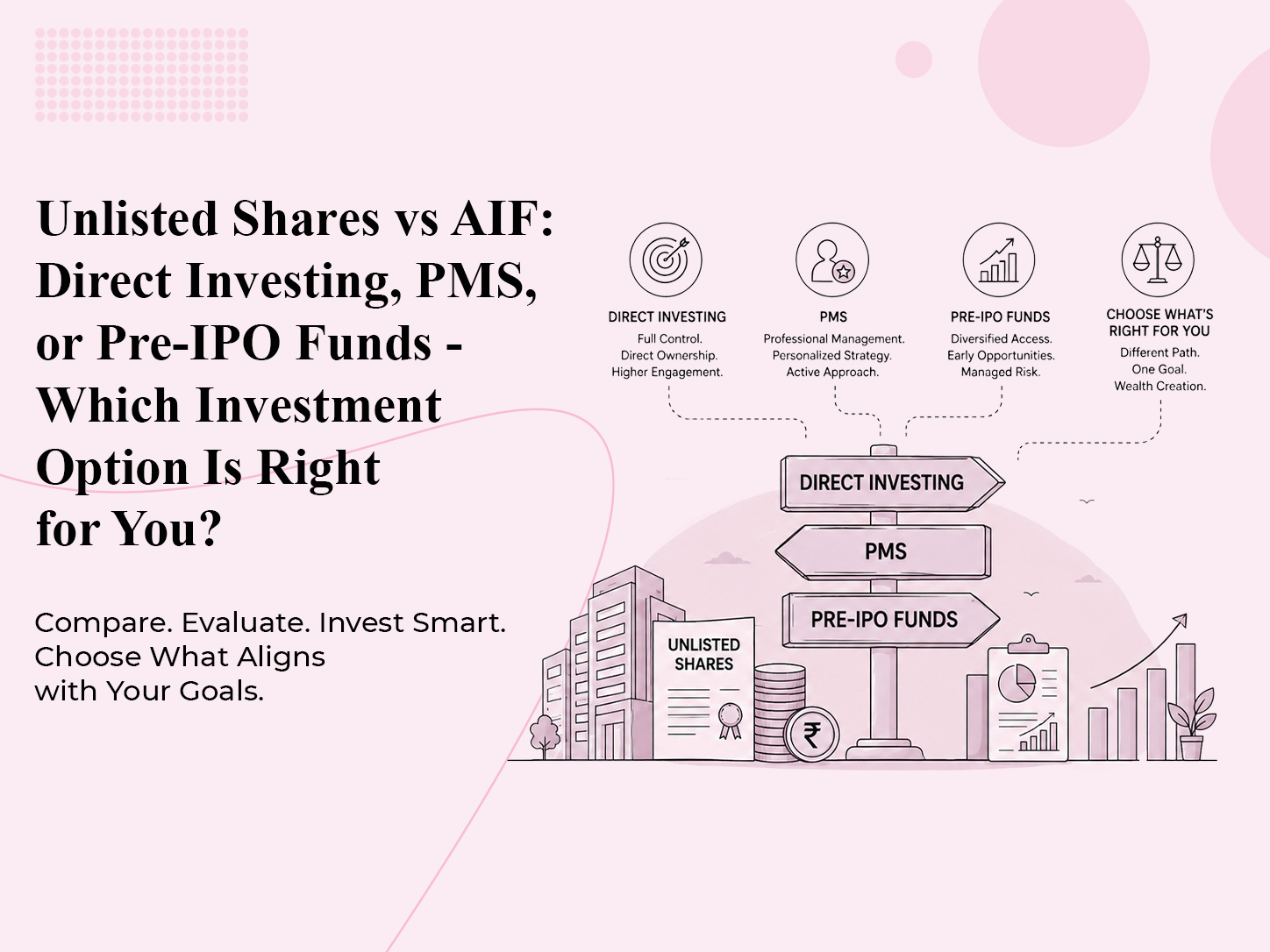
Private market investing used to be the domain of institutional players and venture capital firms. That's changed. High-net-worth individuals, family offices, and experienced retail investors are now looking seriously at unlisted companies to diversify their portfolios and get in early on a company's growth story, long before it rings a bell on any exchange. As more people enter this space, the ways to invest in it have grown too.
You can buy unlisted shares directly, route money through an Alternative Investment Fund, hand things over to a Portfolio Management Service, or put capital into a Pre-IPO fund. All four give you exposure to private companies, but the similarities mostly end with their ownership, control, cost, liquidity, and ticket size vary depending on the path you choose.
This isn't really about which option is objectively "better." The unlisted shares vs AIF debate, and the wider comparison with PMS and Pre-IPO funds, comes down to fit your goals, your risk appetite, and how much time you're willing to spend evaluating companies yourself. This guide walks through how each structure works and what might help you decide.
Buying unlisted shares directly means purchasing equity in a company that isn't listed on a recognised exchange. These deals usually happen in the secondary market: existing shareholders, employees cashing out ESOPs, or early-stage investors looking to exit are the typical sellers. Once the transaction closes, the shares land in your Demat account and you become the legal shareholder.
The appeal here is control. You pick the company, decide how much to put in, and when no fund manager stands between you and the decision. But that freedom cuts both ways: you're on the hook for evaluating financials, valuation, and documents before any money changes hands.
AIFs are privately pooled vehicles regulated by SEBI. Rather than picking companies yourself, you're buying into a fund that a manager runs on your behalf. Most private-market AIF activity in India happens through Category II funds, which tend to focus on longer-term bets. The key difference from direct investing: you own units in the fund, not shares in any company. That means diversification and oversight, but also less say in what gets bought or sold.
PMS exists for investors who want a more tailored hand on the wheel. Unlike an AIF, where everyone's money sits in one pool, PMS accounts are typically managed separately for each client, and depending on the mandate, a portfolio might hold listed stocks, unlisted shares, or both. A portfolio manager still makes the calls, but you get more visibility into what you own which suits people who want customisation without executing every trade themselves.
Pre-IPO funds target companies expected to go public down the line, usually structured as either an AIF or PMS, with the goal of getting in before the IPO happens. Worth keeping in mind: IPO timelines are notoriously unpredictable. Companies delay listings, sometimes cancel them entirely, depending on markets or their own performance. Pre-IPO investing should be treated as a long game, not a bet on a quick payday.
There's a tendency to lump all private-market investments together just because they involve companies that aren't publicly traded. That's a mistake. Each structure produces a genuinely different experience, and the right pick depends on how much control you want, your budget, diversification needs, exit timeline, and comfort with fees.
Someone who enjoys digging into balance sheets might lean toward direct ownership. Someone who'd rather pay for expertise and spread risk might prefer an AIF or PMS. The better question isn't "which makes more money" it's "which structure fits how I want to invest."
Direct investing tends to be the most flexible of the four, mainly because there's no regulatory floor on how much you need to invest. What you'll spend depends on the company's valuation, share availability, and what the seller wants. AIFs sit at the opposite end: SEBI requires most investors to commit at least ₹1 crore, which is why AIFs are really built for HNIs and institutions rather than retail investors. PMS sits in between, with a ₹50 lakh minimum. Pre-IPO funds don't carry a separate threshold, whichever minimum applies to their underlying AIF or PMS structure.
Returns matter, but so does what it costs to get them. Direct investments mostly involve one-time costs brokerage, taxes, transfer charges with no ongoing fee once shares sit in your Demat account. Professionally managed products work differently: both AIFs and PMS charge management fees, and many layers on performance fees tied to returns. Worth asking honestly whether that cost is justified over a multi-year holding period.
This is probably the sharpest line between direct investing and the professionally managed options. With direct unlisted shares, you're the legal owner, and every call which company, how much, when to sell is yours alone. With an AIF, you own fund units, not shares in any specific company, and the manager decides when to buy or sell. PMS lands in the middle: portfolios are usually managed individually, giving more transparency even though the manager still pulls the trigger. Pre-IPO funds, running under either structure, mean trusting a manager to spot IPO potential and hold until an exit window opens.
This is where private-market investing looks nothing like buying a listed stock you can't just sell whenever you feel like it. Direct ownership offers flexibility because investors may sell whenever they find a willing buyer, but actual liquidity depends entirely on market demand. Common exits include secondary sales, buybacks, acquisitions, or an eventual IPO, and for thinly traded companies, finding a buyer can take a while. AIFs are mostly closed-ended, with tenures of five to seven years, and redeeming early generally isn't an option. PMS liquidity depends on the portfolio listed holdings exit faster, unlisted ones behave like direct investments. Pre-IPO funds are tied to a listing timeline that can shift; liquidity here is really a bet on when, or whether, the IPO happens.
A Quick Side-by-Side ComparisonWhich Option Might Actually Suit You?
| Feature | Direct Unlisted Shares | AIF | PMS | Pre-IPO Fund |
| Ownership | Direct shareholder | Fund units | Separately managed portfolio | Depends on structure |
| Investment Decisions | Investor | Fund Manager | Portfolio Manager | Fund Manager |
| Minimum Investment | Varies | ₹1 Crore | ₹50 Lakh | Based on AIF/PMS |
| Diversification | Investor decides | Generally higher diversification than direct investing, depending on the fund strategy | Moderate | Moderate |
| Annual Fees | Minimal | Management + Performance Fee | Management Fee ± Performance Fee | Management + Performance Fee (Varies by Fund) |
| Liquidity | Depends on buyer | Lock-in period | Depends on holdings | Depends on IPO |
| Best For | Experienced investors | HNIs seeking diversification | Investors wanting customised management | Investors targeting IPO opportunities |
There's no universal answer; it comes down to the individual. If you like owning things outright and want full control over entries and exits, direct unlisted shares probably fit best. If diversification matters more than control and you're comfortable with a bigger ticket size, an AIF makes sense. If you want a managed portfolio with more visibility, PMS is worth a look. And if your interest is companies heading toward an IPO, a Pre-IPO fund is built for that.
Before putting money into any private-market option, run through a few basics: understand the structure, check the minimum investment, add up real fees, think about your holding period, assess liquidity needs, confirm the manager's regulatory standing, do independent due diligence, and make sure it fits your financial plan. None of this guarantees a good outcome, but skipping it tends to guarantee a worse one.
A few patterns show up again and again among investors new to this space: jumping in without understanding illiquidity, assuming every private company is destined for an IPO, glossing over fees while comparing headline returns, putting too much money into one company, skipping due diligence because a deal feels urgent, and chasing hype instead of fundamentals. Steering clear of these alone tends to improve outcomes more than picking the "best" structure ever could.
Finding solid opportunities in the unlisted space comes down to two things: reliable information and a transaction process you can trust. Supremus Angel gives investors access to India's unlisted and pre-IPO market by surfacing verified opportunities and supporting secondary transactions company information, documentation, and the Demat transfer process included.
Unlike an AIF or PMS, Supremus Angel isn't managing a pooled portfolio on your behalf. The focus is on facilitating direct investment in unlisted shares, so the due diligence and the final call on fit still rest with you.
Choosing between unlisted shares, an AIF, PMS, or a Pre-IPO fund isn't really about chasing the highest expected return. Each structure trades off ownership, management, diversification, liquidity, and cost differently, and none wins on every dimension at once.
Direct investing rewards people who want control and genuinely don't mind doing their own homework before writing a check. AIFs offer diversification and professional management in exchange for a bigger commitment and a longer lock-in period. PMS gives customised management with more visibility than a pooled fund. Pre-IPO funds focus squarely on companies with listing potential, timeline uncertainty included.
Before committing any capital, look honestly at your financial goals, how long you can stay invested, how much liquidity you need, and how much risk you can stomach. A decision built on real due diligence tends to hold up better than one built on chasing whatever's popular. Done right, private market investing can become a genuinely useful piece of a diversified portfolio as long as the structure matches what you're trying to achieve.
1.What is the main difference between unlisted shares and an AIF?
Direct shares make you the outright owner of a specific company; an AIF pools money with other investors and puts a fund manager in charge.
2.Can retail investors buy unlisted shares?
Yes, direct purchases don't carry the same regulatory minimum as AIFs and PMS, so the entry amount depends on the deal itself.
3.Why do AIFs require such a large minimum investment?
SEBI mandates a ₹1 crore minimum for most AIF investors, aimed mainly at HNIs and institutions rather than retail buyers.
4.Are Pre-IPO funds guaranteed to deliver higher returns?
No. Outcomes depend on company performance, valuation, market conditions, and whether the IPO goes through on schedule.
5.Which option gives investors the most control?
Direct investment in unlisted shares, since every buy, hold, and sell decision stays with the investor.
