
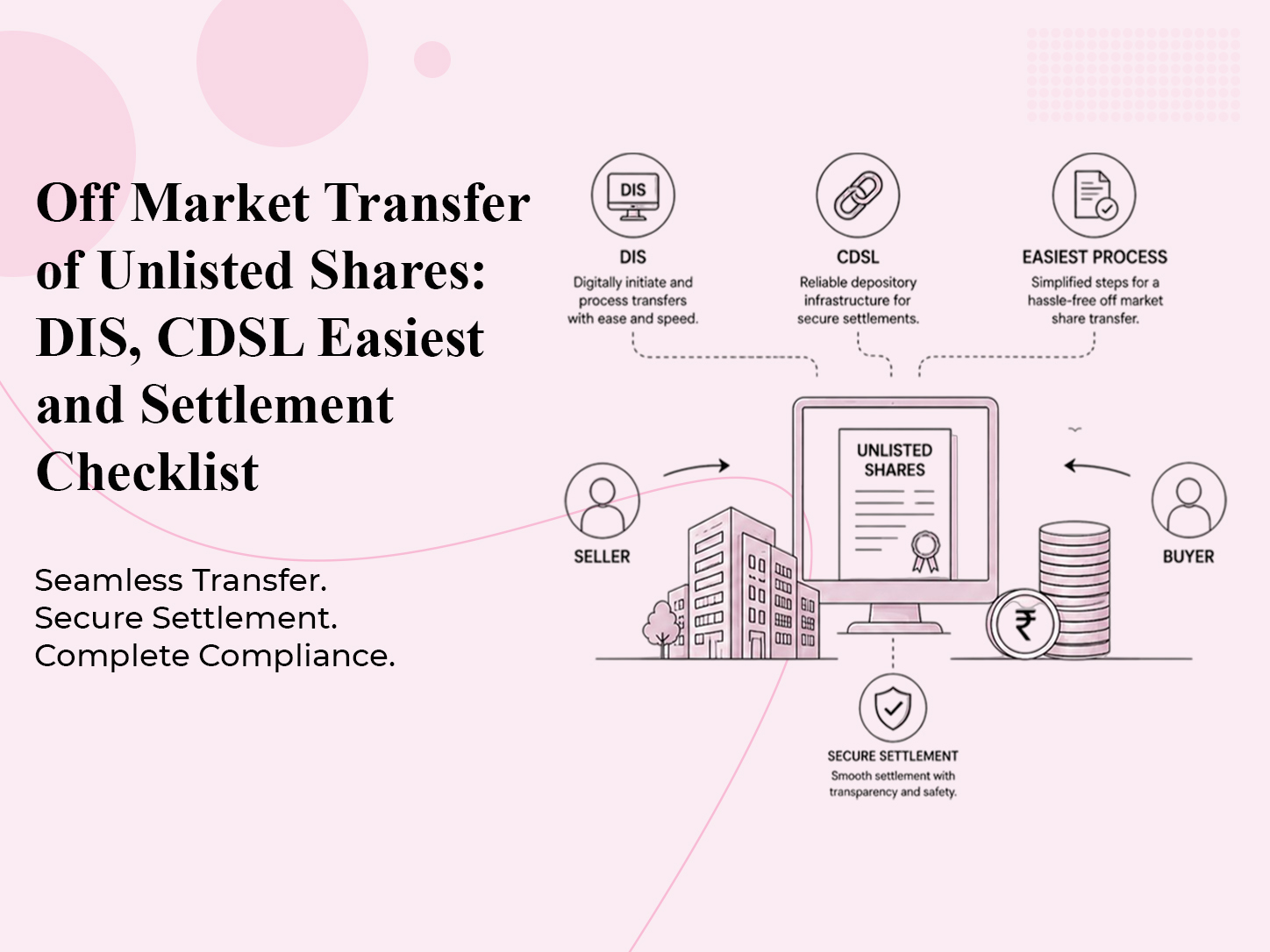
Off market transfer of unlisted shares is how ownership actually changes hands for pre-IPO and unlisted equity - there's no stock exchange in the loop, so the shares move directly between two demat accounts. That absence of an exchange is exactly why paperwork matters so much here. Get the Delivery Instruction Slip or the CDSL Easiest instruction wrong, and settlement can stall or get rejected outright. This piece walks through both routes and what to check before initiating a transfer.
At its core, an off market transfer is movement of securities between two demat accounts, with no stock exchange sitting in between. For unlisted and pre-IPO shares this isn't optional - since these securities don't trade on NSE or BSE, there's no exchange clearing corporation to route the transaction through.
The mechanics: the seller instructs their Depository Participant to debit a certain quantity of shares and credit them to the buyer's account. Both accounts need to sit with a recognised depository - CDSL or NSDL - and the instruction has to name the security correctly through its ISIN. Get that wrong and nothing else about the transfer matters.
Where does this come up? Usually when someone buys unlisted shares directly from an existing shareholder, when ESOPs vest into unlisted stock, or when shares pass through inheritance, a gift, or corporate restructuring.
This isn't just procedural box-checking. Whether ownership is correctly recorded, whether the transaction sits within SEBI's depository rules, whether future dividends or bonus shares land in the right account - all of it traces back to how cleanly this transfer was executed.
Unlisted shares lack the pricing transparency and standardised settlement rails of listed stocks, so the transfer instruction carries more weight - it's effectively the primary evidence of the transaction. A small error can mean delayed settlement, an outright rejection, or a genuine dispute over whether ownership changed at all.
There's a tax angle too: the recorded transfer date determines the holding period, which decides whether gains get taxed as short-term or long-term.
The Delivery Instruction Slip is exactly what it sounds like - a form, physical or digital, through which the seller tells their DP to debit shares and send them to a named recipient. It's still the most common way to execute an off market transfer, especially when the seller's DP hasn't switched on CDSL Easiest.
What has to be on the form: both parties' client ID and DP ID, the ISIN, share quantity, and execution date. The seller also has to sign it, checked against the specimen already on file with the DP.
Where things go wrong most often - a mismatched ISIN, a DP ID or client ID that doesn't quite match, illegible handwriting, or a signature that fails verification. The fix is mostly discipline: confirm counterparty details before filling anything in, check the ISIN against company records rather than memory, and hold onto a copy of the DIS with the DP's acknowledgment once submitted.
CDSL Easiest - Electronic Access to Securities Information and Execution of Secured Transactions, if you need the full name - lets investors submit transfer instructions online instead of a physical slip. It works only if the demat account sits with CDSL and the DP has switched the facility on.
Registration is a one-time form submitted to the DP, after which you get portal login credentials. Depending on the mode, either the DP approves each instruction or you self-authorise as the account holder.
Why bother? Less paper, faster turnaround, no dependence on courier or in-person visits. The catch: it's CDSL-only, your DP has to support it, and registration can take a few working days.
| Document | Purpose | Mandatory |
| Delivery Instruction Slip (physical mode) | Instructs the DP to execute the transfer | Yes, if not using CDSL Easiest |
| CDSL Easiest registration form | Enables online transfer instructions | Yes, for Easiest users |
| Client Master Report (CMR) of buyer | Confirms buyer's DP ID and client ID | Yes |
| PAN card copy | Identity and tax verification | Yes |
| Transfer deed or agreement (where applicable) | Records commercial terms of the transaction | Recommended |
| DP acknowledgment slip | Proof of submission | Recommended for record-keeping |
A physical DIS usually settles in one to three working days, depending on the DP's process and whether manual checking is needed. CDSL Easiest, when self-authorised, can be same-day or next working day - the real draw of using it.
Delays usually trace to an incomplete form, a mismatched signature, an ISIN triggering rejection, or a DP swamped during a busy stretch. Transfers also get rejected if the seller's account lacks a free, unpledged balance covering the quantity.
| Factor | What to Check | Good Sign | Red Flag |
| ISIN accuracy | Matches company's official ISIN | Confirmed against registrar records | Mismatch with company records |
| Account status | Buyer and seller demat accounts are active | Both accounts operational and KYC-compliant | Dormant or frozen account |
| Free balance | Seller holds unpledged, unencumbered shares | Balance confirmed via holding statement | Shares under lien or pledge |
| Signature match | Seller's signature matches DP records | Verified against specimen signature | Mismatch flagged by DP |
| Submission mode | DIS or CDSL Easiest correctly used | Correct form for DP's supported mode | Wrong instrument submitted |
| Acknowledgment | Proof of submission obtained | DP-stamped acknowledgment retained | No proof of submission |
An incorrect ISIN tops the list - unlisted companies sometimes have similarly named securities. A wrong DP ID or client ID on the recipient side is just as bad; the depository can't find an account that doesn't exist as specified.
Signature mismatches cause plenty of delay, as does skipping consideration details when the transfer ties to a sale needing tax documentation later. Submitting close to the DP's daily cutoff can push settlement to the next day, and missing documents can hold things up even after the DIS has cleared.
| Feature | DIS | CDSL Easiest |
| Mode | Physical or scanned form | Fully online |
| Registration required | No prior registration needed | One-time registration with DP |
| Processing speed | One to three working days typically | Often same day or next working day |
| Paperwork | Physical slip and signature | Digital submission and authentication |
| Applicable depositories | CDSL and NSDL | CDSL only |
| Suitability | One-off or infrequent transfers | Frequent transfers, digitally comfortable investors |
There's no single right answer here - it depends on how often you're transferring, how comfortable you are with an online portal, and whether your DP even supports Easiest for your account. For a one-off transaction, a physical DIS is probably fine. Expect to do this more than once, and the faster turnaround on Easiest starts to matter more.
Beyond frequency, think about documentation discipline, your DP's internal process, and any charges tied to a DIS. Policies aren't uniform across DPs, so it's worth confirming directly with yours before committing to either route.
Supremus Angel helps investors work through the off market transfer process - documentation requirements, realistic timelines, what to expect at each stage. That includes confirming correct ISIN and counterparty details, supporting due diligence on the securities involved, and walking investors through settlement so nothing gets missed. The goal: fewer avoidable errors, and a transfer that settles without unnecessary back-and-forth.
However you execute it - physical DIS or CDSL Easiest - an off market transfer of unlisted shares comes down to getting the documentation right. Knowing the mandatory fields, the usual rejection reasons, and realistic settlement timelines goes a long way toward avoiding delays and disputes. The appropriate transfer method depends on investor requirements, operational convenience, and compliance considerations. Investors should evaluate documentation, settlement procedures, and regulatory requirements carefully before initiating an off-market transfer of unlisted shares.
1.What is off market transfer of unlisted shares?
Shares moving between demat accounts without going through a stock exchange - used mainly for pre-IPO and unlisted securities.
2.Is DIS mandatory?
Only if your DP hasn't enabled CDSL Easiest for your account, or you haven't registered for it yourself.
3.Can CDSL Easiest transfer unlisted shares?
Yes, as long as the shares sit in a CDSL demat account and your DP supports the facility.
4.How long does settlement take?
Usually one to three working days for a DIS; CDSL Easiest tends to be quicker.
5.What documents are required?
The DIS or Easiest instruction itself, the buyer's CMR, PAN details, and a transfer deed if one applies.
6.Is stamp duty applicable?
Yes, at whatever the current government rate is - worth checking before you execute, since rates can change.
7.Can transfers be rejected?
They can - ISIN mismatches, wrong account details, signature issues, or shares under pledge are the usual culprits.
8.What happens after settlement?
The buyer's account shows the credit, and the seller's statement reflects the matching debit.
9.Can NRIs use off-market transfers?
Yes, but it's subject to RBI and FEMA rules that govern NRI investment in unlisted shares.
10.How can investors avoid transfer errors?
Mostly by double-checking ISIN, counterparty details, and signature accuracy before submitting - it catches most common issues.
