
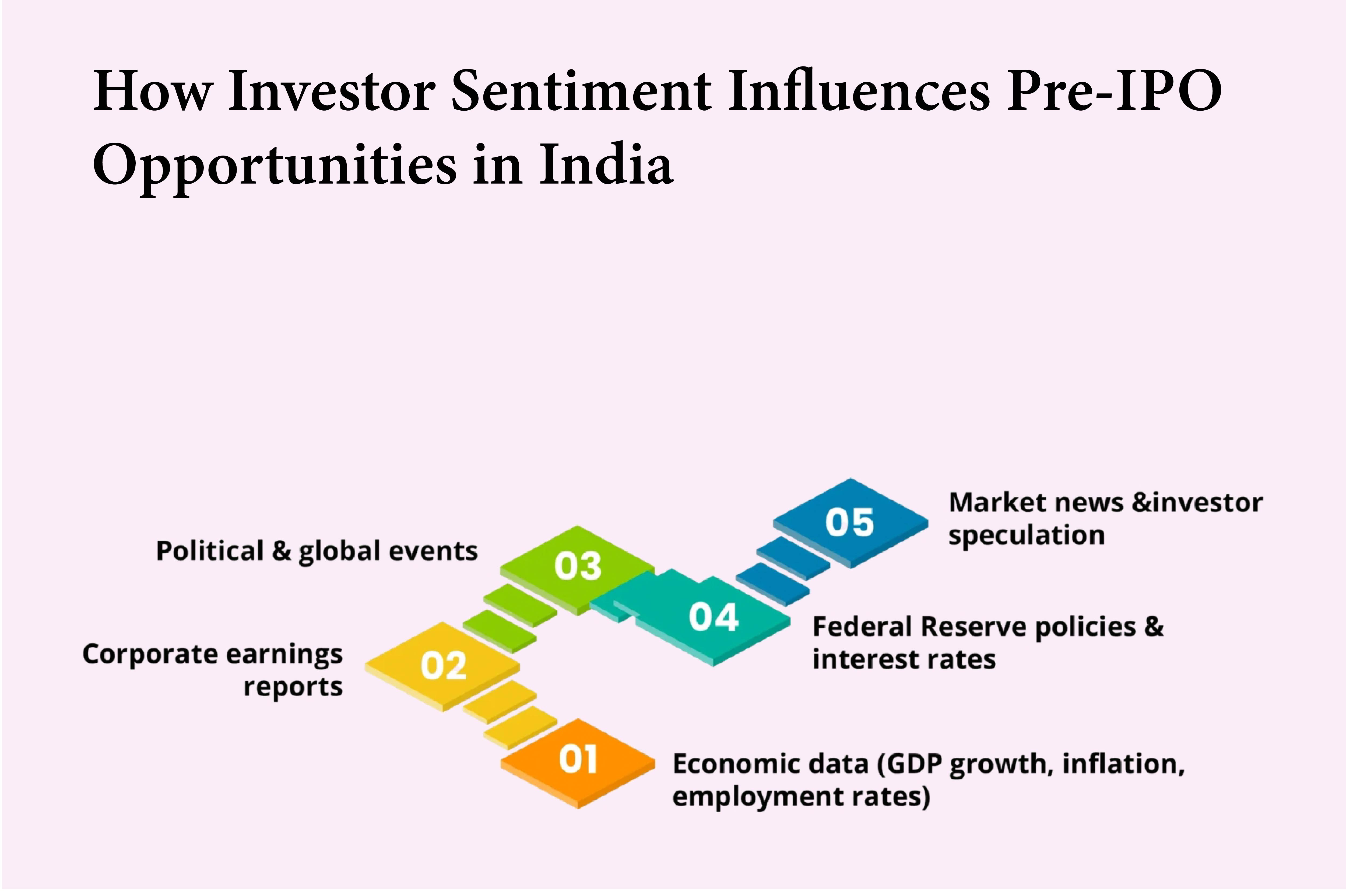
Investor sentiment before an IPO refers to the collective confidence, expectations, and risk appetite that participants bring to unlisted companies in the period before a public listing. Factors such as pricing, liquidity, demand, and deal participation are all shaped by this broader mood making sentiment one of the most influential forces in India's pre-IPO market. Cautious sentiment may also cause reductions in transaction activity and valuations, whilst strong positive sentiment can drive increased interest in unlisted shares. The idea is to help investors assess market behaviour more rationally, instead of speculation, hype or merely discussion about the grey market with no neutral stance on pre-IPO opportunities in India.
Defining Investor sentiment pre IPO refers to how investors in aggregate feel about a company, industry, or the broader market before a business is publicly listed on stock exchanges. Sentiment doesn't always correlate to stock-price performance. Instead, it reflects expectations.
Sentiment in the Indian unlisted space can be driven by:
So if the technology IPOs are attracting good market spots, the appetite for technology-centric unlisted shares may also increase considerably. Conversely, the enthusiasm of even fundamentally solid companies can be sapped by a cold reception in the public markets.
This is why investor sentiment often influences this process before the IPO:
This relationship is important to understand because the pre-IPO market functions much differently than listed markets, where price discovery would end up being somewhat more transparent.
Investor sentiment is important because pre-IPO investing has less public information, lower liquidity and more uncertainty than listed equities.
In public markets, investors have access to:
In comparison, unlisted market participants are typically dependent on:
This is how sentiment becomes the driving force behind decision making.
When investor confidence is high:
This can establish fiercesome momentum centred around certain industries like that of fintech, logistics and manufacturing or from consumer technology.
When sentiment weakens:
This change is most apparent in bear markets and global uncertainty.
As a result, investor sentiment prior to an IPO impacts both opportunity creation and risk perception.
Investor behaviour in India’s pre-IPO ecosystem is informed by a multitude of interconnected factors.
One of the largest influencers is how new IPOs react post listing.
If recently listed companies:
Then, the confidence of investors towards these unlisted companies that are similar to listed equities often improves.
But a number of weak listings will mean the market psyche is badly affected.
Investors begin questioning:
Such a move generally affects secondary market trading in unlisted shares.
Investor sentiment often shifts between sectors.
Strong sentiment has been visible at different points in India regarding:
When sentiment becomes stronger than fundamentals or the lack of them. Investors can chase the fact that a sector is hot and you see companies get chased up aggressively for no other apparent reason than that it is in a "hot" sector.
This gives rise to a requirement for rational assessment.
Institutional investment also typically improves market sentiment when these larger entities take part in funding rounds or strategic investments.
Investors view institutional participation as:
Yet, institutional investing in and of itself is not a silver bullet that guarantees future success.
Pre IPO, macroeconomic conditions have a large impact on investor sentiment.
Important factors include:
For example:
The pre-new issue market is tied to larger capital market cycles.
Private markets are heavily sentiment driven with information availability.
Unlisted businesses, unlike listed companies typically have:
Consequently, the psychology of investors can be greatly swayed by:
That is why disciplined analysis is even more important.
Valuation over the short term (in pre-IPO markets) is not merely determined by financial metrics.
Sentiment affects:
This is exactly why valuation discipline is important.
Even a company with solid fundamentals needs to be valued based on your analysis, and as you can see excessive exuberance from investors can overvalue the firm.
In the same way, access to quality businesses can be much cheaper with poor sentiment.
Perhaps the biggest mistake in pre-IPO investing is weighing sentiment vs business quality.
Just because someone has a positive sentiment, it does not imply:
Similarly, the sentiment is weak and does not translate broadly to a deterioration in fundamentals.
| Factor | What to Check | Good Sign | Red Flag |
| IPO Market Conditions | Recent IPO performance | Stable post-listing price actions | Multiple weak listing |
| Sector Sentiment | Capital inflows and market demand | Sustainable sector debt | Hype-driven speculation |
| Valuation | Comparison with peers | Reasonable pricing | Excessive premium valuation |
| Institutional Interest | Institutional participation quality | Strong governance confidence | Lack of credible institutional participation |
| Liquidity | Secondary market activity | Consistent buyer interest | Illiquid market |
| Financial Performance | Revenue and profitability trends | Improving business metrics | Weak fundamentals |
| Governance | Management credibility | Transparent communication | Limited disclosures |
| IPO Readiness | Public market preparedness | Structured growth plans | Unclear IPO pathway |
| Aspect | Sentiment-Driven Approach | Fundamental Approach |
| Main Focus | Market excitement | Quality of business |
| Basis of Decision | Trends in demand | Financial analysis |
| Level of Risk | More volatile | More structured assessment |
| Valuation Discipline | Weaker | Stronger |
| Holding Behaviour | Short-term oriented | Long-term focussed |
| Reliance on Information | Narratives | Operations |
| Sustainability | Depends on market mood | Execution |
Well, in practice sentiment and fundamentals always count. Yet, investors must not make a mistake based solely on market psychology.
A common mistake is that investors continuously assume high demand must equate to quality.
In reality:
In fact, strong businesses can become very expensive.
Investors should analyse:
There are many pre-IPO companies which will not be listed.
There are many reasons IPO timelines might change:
Investors should evaluate uncertainty carefully.
Yes, the unlisted market is less liquid than public exchanges.
Sentiment cycles can lead to sharp decreases in buyer demand.
Relying entirely on:
can lead to poor decision-making.
Independent research remains critical.
Investor sentiment prior to IPO carries excessive risk when times are too rosy.
Investors need to be circumspect where it comes to:
However, at times uncertain market conditions can offer opportunities for patient investors prepared to approach businesses with an even-handed logic.
The right approach depends on:
There is no universal formula.
Supremus Angel will enable the pre-IPO and unlisted shares ecosystem by providing access to data, opportunities, and market insights for investors in private market investing.
Creation consist of platforms able to connect well in a market where information is often a fragmented bubble, such Supremus Angel:
With the impact of investor sentiment pre IPO on valuations and decision making, access to credible information and disciplined evaluation frameworks is more important than ever before.
Investors should independently assess:
prior to partaking in any pre-IPO opportunity.
Besides, the unlisted shares market of India is largely influenced by investor sentiment pre IPO. It regulates the pricing, liquidity, demand and investor behaviour in every market cycle. Nevertheless sentiment should never be a substitute for structured analysis.
Pre-IPO opportunities that are accessible and successful usually require:
Investors who blend a disciplined approach to analyzing fundamentals and cash flows along with an understanding of market psychology are probably going to make better decisions in the pre-IPO space as India’s private market ecosystem continues to evolve.
Q1. Why should I care about sentiment if I'm focused on fundamentals?
Because in the pre-IPO market, sentiment moves prices faster than financials do ignoring it is expensive.
Q2. Does positive sentiment always mean the share price will go up?
Not always, sometimes the price has already run up because of the sentiment, leaving very little upside for late entrants.
Q3. Can a good company suffer because of bad market sentiment?
Yes, genuinely strong businesses lose buyer interest all the time simply because the broader mood has turned cautious.
Q4. What actually shifts investor sentiment in India's pre-IPO space?
Mostly recent IPO results when listings disappoint back to back, appetite for unlisted shares drops across the board.
Q5. How do I know when sentiment is running ahead of reality? When everyone around you is excited about a company but nobody can clearly explain the revenue model, that's your signal.
Q6. Does a big institutional investor backing a company change how others feel about it?
Hugely retail investors take it as a green flag, even though institutions have backed plenty of companies that went nowhere.
Q7. Is there a right time to enter based on sentiment cycles?
Patient investors who enter during low-sentiment phases when others are stepping back often get the better entry prices.
Q8. Can sentiment push a pre-IPO valuation beyond what makes sense?
It happens constantly hype-driven demand regularly prices unlisted shares at levels the business cannot justify yet.
Q9. What's the single biggest mistake investors make around pre-IPO sentiment?
Mistaking market excitement for due diligence popularity of a deal is not the same as quality of a deal.
