
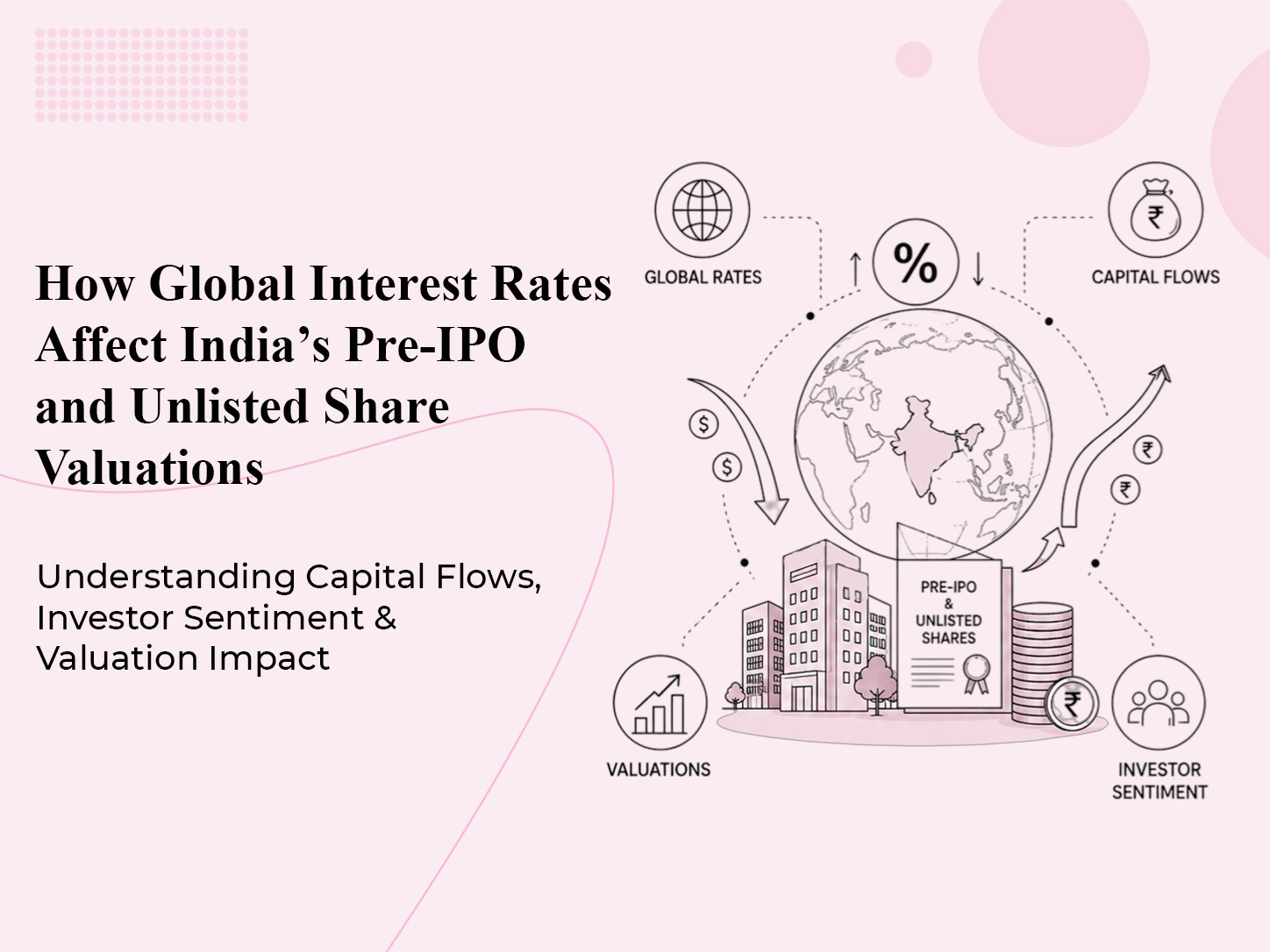
Global borrowing costs influence far more than bank loans and bond yields. The interest rates impact on pre IPO valuations appears through liquidity, funding availability, and the price assigned to future earnings. Indian unlisted companies do not trade every day on an exchange, yet their valuations still respond to global monetary conditions. Expensive capital usually makes investors selective and narrows valuation multiples.
Interest rates are the price paid for using capital. Central banks influence that price through policy rates and liquidity operations. In India, the Reserve Bank of India shapes domestic borrowing conditions. The US Federal Reserve also matters because the dollar remains central to global funding and portfolio flows.
A private company may not have a quoted market price, but buyers still need a way to decide what its shares are worth. They commonly study listed peers, funding rounds, discounted cash flow estimates, and expected IPO pricing.
Suppose an unlisted technology business expects most of its profits five years from now. Those profits are less valuable today when investors can earn a stronger return from government bonds or high-quality debt. The business may remain operationally strong, but investors may still refuse the earlier valuation.
Pre-IPO investors commonly face limited disclosure, restricted liquidity, and uncertain exit timing. Higher interest rates make each disadvantage more important.
Investors demand a larger return premium for illiquid securities, funding-dependent companies struggle to raise capital, and IPO plans may be delayed.
Interest rates also influence negotiation power. During abundant liquidity, popular companies can defend premium valuations. In a tight cycle, investors may insist on lower prices, stronger rights, or a clearer path to profitability. The same company can therefore receive very different offers across two macroeconomic environments.
The connection is not mechanical, but several channels repeatedly appear.
When developed-market bond yields rise, institutions have less reason to take additional risk in emerging-market private assets. Capital may shift toward dollar debt or government securities.
The RBI’s policy stance affects bank lending rates, corporate borrowing costs, consumer demand, and financial-system liquidity. Companies needing working capital, expansion loans, or refinancing feel the effect directly.
A widening rate difference between countries can influence currency flows. A weaker rupee may raise imported costs or foreign-currency liabilities, while making Indian assets cheaper for overseas investors. The final valuation effect depends on the company’s revenue mix, cost structure, and funding profile.
Unlisted shares are frequently priced with reference to listed peers. If listed fintech, software, consumer, or financial-services companies lose valuation multiples during a high-rate period, private-market sellers cannot easily justify old premiums.
Venture capital and private equity funds become more selective when their own investors slow commitments. Due diligence takes longer, return thresholds rise, and weaker companies struggle to close rounds.
Not every pre-IPO company reacts equally.
Profit timing: Businesses earning cash far in the future are more sensitive to higher discount rates.
Funding dependence: A long cash runway reduces immediate funding risk.
Debt burden: Rising rates can raise interest expense and complicate refinancing.
Pricing power: Companies that can pass higher costs to customers may protect margins better.
Business quality: Strong governance, recurring revenue, and healthy unit economics can support demand.
Sector characteristics: Long-duration growth businesses often see sharper multiple compression than cash-generative companies.
IPO readiness: Clean audits, predictable reporting, regulatory compliance, and institutional governance make a company easier to evaluate and may reduce the discount investors demand.
| Area | Rising-rate environment | Falling-rate environment |
| Investor appetite | More selective and valuation conscious | Greater willingness to consider growth assets |
| Funding rounds | Slower, smaller, or more structured | Faster execution and stronger competition |
| Valuation multiples | Often compress | May expand |
| IPO activity | Frequently delayed or cautiously priced | Usually improves if earnings remain supportive |
| Debt costs | Higher refinancing and interest burden | Lower financing pressure |
| Exit visibility | Less certain | Potentially clearer |
| Secondary demand | Can weaken | Can recover |
Falling rates do not automatically create good investments. Cheap capital can encourage unrealistic projections, while rising rates may expose weak models.
Step 1: Identify the rate cycle
Study inflation, central-bank language, bond yields, liquidity, and credit growth.
Step 2: Understand the company’s cash needs
Review cash flow, cash balance, debt maturities, and likely fundraising requirements.
Step 3: Separate growth from cash burn
Compare customer acquisition cost, contribution margin, operating losses, and cash burn.
Step 4: Recheck the valuation benchmark
Compare the proposed price with listed peers, private transactions, and the last funding round. Adjust for liquidity, governance, profitability, and scale.
Step 5: Test different exit dates
Do not assume the IPO will occur on the original schedule. Test a delay of one, two, or three years.
Step 6: Examine debt and refinancing risk
Study interest coverage, maturity, floating-rate exposure, and foreign-currency borrowing.
Step 7: Review management behaviour
Check whether management protects cash and communicates realistically.
Step 8: Decide the required margin of safety
The margin of safety should reflect illiquidity, disclosure gaps, execution risk, and exit timing.
| Factor | What to Check | Good Sign | Red Flag |
| Revenue | Growth quality and customer concentration | Broad, repeatable growth | Growth dependent on one client |
| Cash flow | Operating cash generation | Improving cash conversion | Losses widening despite scale |
| Cash runway | Months before new funding is required | Comfortable runway | Urgent capital requirement |
| Debt | Cost, maturity, and coverage | Manageable repayments | Near-term refinancing pressure |
| Valuation | Premium to peers and past rounds | Supported by performance | Premium based mainly on IPO rumours |
| Governance | Audits, disclosures, and board quality | Timely and consistent reporting | Related-party opacity |
| IPO readiness | Regulatory and financial preparation | Clear, credible process | Repeated delays without explanation |
| Liquidity | Secondary demand and transfer process | Documented transaction route | Unclear exit mechanism |
| Sector | Rate sensitivity and demand outlook | Resilient demand | Highly discretionary spending exposure |
| Management | Capital allocation and communication | Disciplined execution | Aggressive projections without evidence |
One common error is treating the latest funding-round valuation as permanent market value.
A respected brand does not guarantee IPO success. Public investors still assess earnings quality, governance, valuation, and market conditions.
Investors also overfocus on rate cuts. Markets may price expected easing early, making overpayment possible.
Ignoring dilution is another error. A down round may reduce existing holders’ economic interest.
Investors also compare unlisted shares with listed peers without allowing for illiquidity.
The decision should begin with company quality. Interest rates cannot repair poor governance, weak economics, or unreliable reporting.
A sensible approach is to ask three questions. Is the business financially capable of surviving a difficult funding environment? Is the proposed price reasonable after adjusting for illiquidity and execution risk? Can the investor hold the shares if the IPO is delayed?
During rising-rate periods, profitable companies with manageable debt, recurring revenue, and adequate cash reserves may deserve closer attention. During falling-rate periods, investors should remain cautious about inflated projections and rapid multiple expansion. In both cases, the purchase price matters.
Supremus Angel helps investors research pre-IPO and unlisted shares by sharing relevant company information, explaining transaction documentation, and supporting the transfer process. Investors can use this information to compare valuation, business performance, governance, and liquidity before reaching an independent decision.
The platform’s role is informational and procedural. It cannot remove market risk, guarantee an IPO, or assure returns. Outcomes depend on company performance, entry valuation, market conditions, and the investor’s ability to hold an illiquid asset.
The interest rate's impact on pre IPO valuations works through several connected forces: discount rates, funding availability, public-market benchmarks, debt costs, investor appetite, and exit visibility. None of these should be assessed in isolation. Context matters because identical rate changes produce unequal outcomes. A rising-rate cycle can reveal fragile business models, while a falling-rate cycle can make weak assumptions look temporarily credible.
Investors should therefore combine macroeconomic awareness with detailed company analysis. Profitability, cash runway, governance, debt, valuation, and IPO readiness remain central. Global rates help explain the environment in which a price is negotiated; they do not determine whether the underlying company deserves investment. Careful evaluation, realistic exit assumptions, and valuation discipline remain essential in every interest-rate cycle.
Disclaimer: This article is for educational purposes only and does not constitute investment advice or a recommendation to buy or sell securities. Unlisted shares involve business, valuation, liquidity, regulatory, and exit risks. Investors should evaluate carefully and seek professional guidance where appropriate.
1.How do interest rates affect pre-IPO valuations?
Higher rates generally increase required returns and reduce the present value of future profits. They can also restrict funding and compress comparable-market multiples.
2.Why does the US Federal Reserve matter to Indian unlisted companies?
Federal Reserve policy affects global liquidity, dollar strength, and institutional capital allocation. These forces influence foreign investment appetite for Indian private assets.
3.Does a rate hike always reduce an unlisted share’s price?
No. The impact depends on profitability, debt, sector, funding needs, governance, and investor demand. Some resilient companies may retain valuation support.
4.Can lower interest rates improve IPO activity?
Lower rates can improve risk appetite and support valuation multiples, but IPO activity also depends on earnings, market confidence, regulation, and company readiness.
5.Which pre-IPO sectors are most rate sensitive?
Technology, fintech, consumer internet, infrastructure, and other funding-dependent or debt-heavy sectors often show greater sensitivity.
6.How does the RBI repo rate affect private companies?
It influences domestic borrowing costs, liquidity, credit demand, and consumer spending. The effect varies according to the company’s balance sheet and business model.
7.Should investors wait for rates to fall?
Timing an investment only around rates is unreliable. Investors should evaluate company quality, valuation, liquidity, and holding capacity together.
8.Why do startup valuations fall during tight liquidity?
Investors apply higher return requirements, funding becomes scarce, and companies have less negotiating power. Long-dated growth projections also receive lower present values.
9.What indicators should investors monitor?
Useful indicators include central-bank guidance, inflation, bond yields, credit conditions, fundraising activity, listed-peer valuations, currency movements, and IPO issuance.
10.Can a strong company still face valuation pressure?
Yes. A sound business may trade at a lower valuation when market liquidity declines. Operational strength and market price are related, but they are not identical.
