
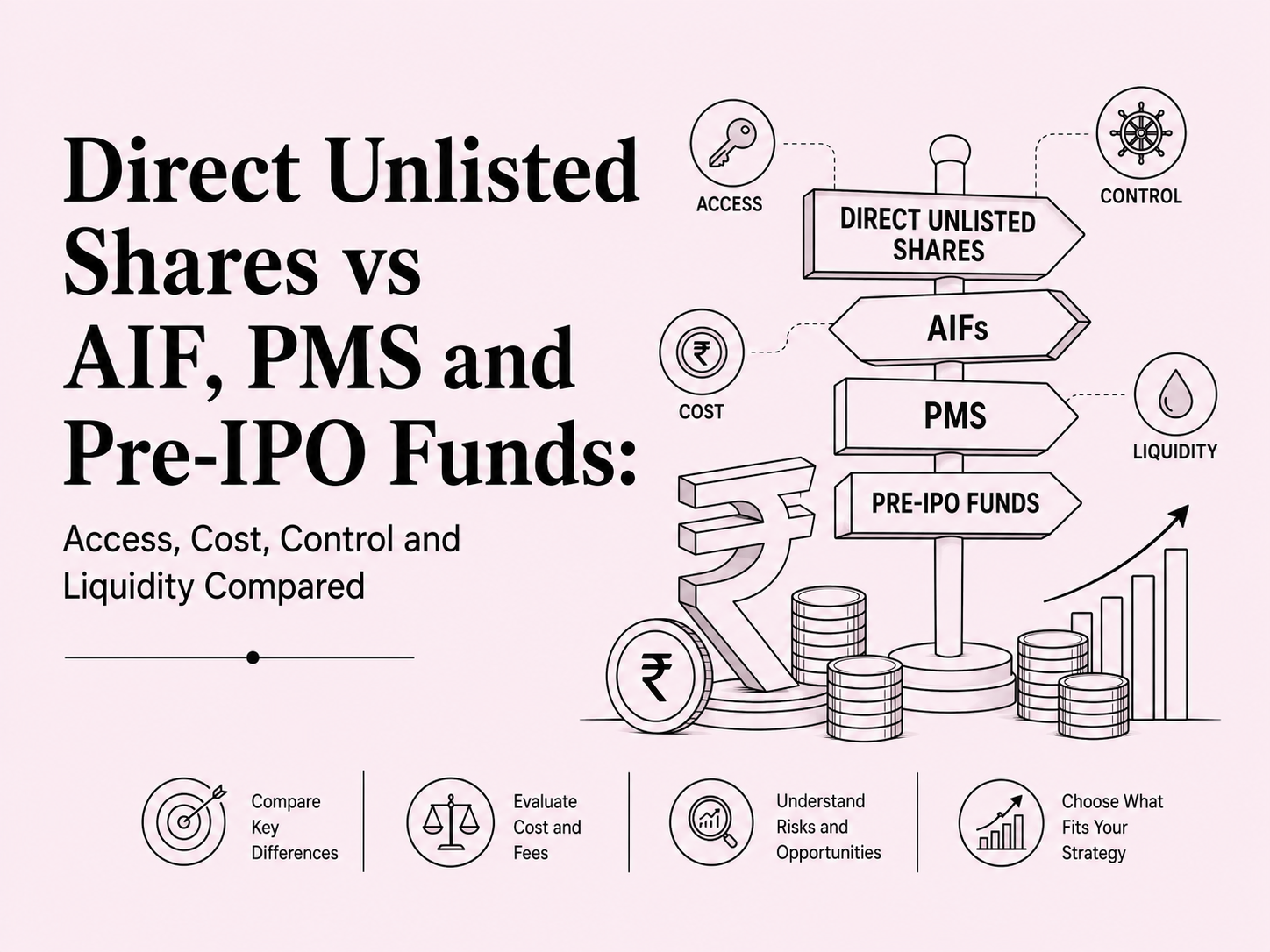
Comparing unlisted shares vs AIF is one of the first steps for investors deciding how to participate in India's private markets. Direct unlisted shares involve buying equity in a specific company and holding it in demat form, while AIFs, PMS and pre-IPO funds pool investor capital under professional management. Each route differs in minimum investment, cost structure, control, and liquidity. This article compares these options factually so investors can evaluate which structure aligns with their objectives.
Direct investment means an investor buys shares of a company that is not listed on a stock exchange and holds them directly in their own demat account. Ownership is recorded in the investor's name, and the shares are transferred through off-market transactions facilitated by a broker, platform, or intermediary.
Key characteristics of direct unlisted share ownership include:
Because there is no fund manager or intermediary layer, direct ownership places research, due diligence, and decision-making entirely with the investor.
Alternative Investment Funds (AIFs) are privately pooled investment vehicles regulated by SEBI under the AIF Regulations, 2012. AIFs are categorized as Category I, II, or III depending on their investment strategy and risk profile. Category I funds typically invest in early-stage or socially beneficial ventures, Category II funds cover private equity and debt strategies without leverage, and Category III funds may use complex trading strategies, including leverage. Investors in an AIF are unit holders, and the fund manager makes underlying investment decisions on their behalf.
Portfolio Management Services (PMS) involve a SEBI-registered portfolio manager managing a segregated portfolio of securities on behalf of an individual investor, based on a chosen strategy. Unlike an AIF, PMS holdings are typically held in the investor's own demat account, though investment decisions rest with the portfolio manager rather than the investor.
Pre-IPO funds are investment vehicles, often structured as AIFs or similar pooled entities, that focus specifically on acquiring stakes in companies expected to list in the near to medium term. Investors in a pre-IPO fund own units of the fund, not direct shares of the underlying companies.
In each of these structures, a professional manager selects securities, monitors the portfolio, and executes entry and exit decisions, while the investor's role is largely that of a capital contributor and unit holder.
Investors evaluate AIF vs direct investment in unlisted shares for several practical reasons:
These differences shape which route is more appropriate depending on an investor's objectives, capital, and involvement preference.
| Feature | Direct Unlisted Shares | AIF | PMS | Pre-IPO Fund |
| Minimum investment | Varies by company and platform, often lower than fund structures | Typically ₹1 crore (as per SEBI norms) | Typically ₹50 lakh (as per SEBI norms) | Often ₹1 crore or more, depending on the fund |
| Investor eligibility | Open to eligible investors as per platform/company norms | Restricted to investors meeting SEBI's AIF eligibility criteria | Restricted to investors meeting PMS eligibility criteria | Similar to AIF eligibility, since most are AIF-structured |
| Ownership structure | Direct shareholder in the company | Unit holder in the fund | Direct securities held in investor's own demat account | Unit holder in the fund |
| Cost structure | Brokerage/transaction charges per deal | Management fee plus performance/carry fee | Management fee, and sometimes performance fee | Management fee plus performance/carry fee |
| Portfolio visibility | Full visibility of the specific holding | Periodic fund-level disclosures | Reasonable visibility since securities sit in investor's demat | Periodic fund-level disclosures |
| Liquidity | Depends on finding a buyer in the secondary market | Subject to fund tenure and redemption terms | Subject to strategy and exit terms, generally more flexible than AIF | Subject to fund lock-in and portfolio company listing timelines |
| Lock-in | No formal lock-in, but practical liquidity constraints exist | Often has a defined fund tenure with limited early exit | Usually lower or no formal lock-in | Typically locked until underlying companies list or are sold |
| Decision-making authority | Investor decides company, price, and timing | Fund manager decides | Portfolio manager decides, sometimes with investor input | Fund manager decides |
| Diversification | Depends on investor's own portfolio construction | Usually diversified across multiple companies | Varies by strategy | Usually diversified across pre-IPO opportunities |
| Regulatory oversight | Governed by Companies Act and general securities regulations | SEBI-regulated under AIF Regulations | SEBI-regulated under PMS Regulations | SEBI-regulated where structured as an AIF |
Direct unlisted shares are generally accessible to investors who meet a platform's or intermediary's onboarding requirements, and ticket sizes can be more flexible depending on the specific company and seller. AIFs and PMS, by contrast, have SEBI-mandated minimum investment thresholds and are positioned for investors who meet defined net worth or investment capacity criteria. Onboarding for funds typically involves a formal subscription process, including a private placement memorandum or disclosure document, KYC, and fund agreements, while direct share transactions involve share transfer forms, demat instructions, and transaction agreements between buyer and seller.
Cost structures differ meaningfully across these options:
Costs and risks differ across products, and investors should review offering documents carefully to understand all applicable charges, including any hidden costs such as exit loads or administrative fees, rather than relying solely on headline fee percentages.
Direct unlisted share investors retain full control over stock selection, entry price negotiation, and exit timing, since there is no intermediary decision-maker. Voting rights, where applicable, rest directly with the investor as the registered shareholder. In AIFs and pre-IPO funds, the manager controls company selection and exit timing, and investors participate as unit holders without direct voting rights in the underlying companies. PMS sits in between, since securities are held in the investor's own name, but investment decisions are typically delegated to the portfolio manager, with the degree of investor involvement depending on the specific mandate.
Liquidity in unlisted shares depends on finding a counterparty willing to transact at an agreeable price, since there is no continuous exchange-traded market. AIFs and pre-IPO funds usually have a defined tenure, and redemption before maturity may be restricted or unavailable, depending on the fund's terms. PMS structures can offer relatively more flexibility for entry and exit compared to AIFs, though this varies by portfolio manager and strategy. Across all these routes, realistic liquidity expectations should account for lock-in periods, fund tenure, and the time typically required to identify buyers or sellers in private markets.
Step 1 — Investment objective: Clarify whether the goal is targeted exposure to specific companies or broader private market participation.
Step 2 — Investment size: Match available capital against minimum ticket sizes for each route.
Step 3 — Desired control: Assess whether direct decision-making is preferred over delegated management.
Step 4 — Diversification needs: Consider whether a single-company holding or a diversified portfolio is more suitable.
Step 5 — Liquidity preference: Evaluate comfort with extended holding periods versus the possibility of earlier exit.
Step 6 — Research capability: Determine whether sufficient time and expertise exist for independent due diligence.
Step 7 — Risk tolerance: Factor in concentration risk for direct holdings versus diversified but manager-dependent risk in funds.
Step 8 — Time horizon: Align the chosen structure with realistic timelines for capital deployment and exit.
These scenarios are illustrative and educational, not individualized recommendations.
| Factor | What to Check | Good Sign | Red Flag |
| Investment objective | Alignment with personal financial goals | Clear match with stated objective | Investment chosen without a defined purpose |
| Minimum ticket size | Whether it fits available capital | Comfortable allocation within overall portfolio | Overcommitting a large share of net worth |
| Fees | Full fee schedule, including hidden costs | Transparent, clearly disclosed fee structure | Vague or undisclosed charges |
| Liquidity | Expected holding period and exit process | Realistic timeline communicated upfront | Exit process unclear or undocumented |
| Portfolio transparency | Access to holdings and performance updates | Regular, detailed disclosures | Limited or delayed reporting |
| Diversification | Spread across companies or sectors | Reasonable diversification for the strategy | Excessive concentration in one company or sector |
| Manager track record | History and consistency of past performance | Verifiable track record with disclosed methodology | Unverifiable or exaggerated claims |
| Exit options | Defined mechanisms for liquidity events | Multiple realistic exit routes | Reliance on a single uncertain exit path |
| Documentation | Completeness of legal and offering documents | Comprehensive, SEBI-compliant documentation | Missing or incomplete paperwork |
| Tax implications | Applicable tax treatment for the structure | Clear guidance sought from a tax advisor | No consideration of tax impact |
| Regulatory disclosures | SEBI registration and compliance status | Verifiable regulatory registration | Absence of regulatory oversight |
| Risk concentration | Exposure to a single company, sector, or manager | Balanced exposure aligned with risk appetite | Disproportionate exposure to one entity |
Suitability depends on the investor's objectives, risk tolerance, liquidity needs, capital availability, research capability, and desired portfolio strategy, rather than any single structure being universally superior.
Each option carries distinct trade-offs, and professional advice may be appropriate depending on individual circumstances before committing capital to any of these structures.
Supremus Angel operates as a platform that facilitates access to verified unlisted share transactions for investors exploring direct ownership in private companies. The platform supports the documentation and transaction process involved in transferring unlisted shares, helping investors navigate the practical steps of an off-market transaction. Supremus Angel also helps investors understand the range of opportunities available in the unlisted shares market, offering a structured approach to researching and evaluating direct private market investments. This support is informational and process-oriented, and does not constitute investment advice or a guarantee of outcomes.
Comparing unlisted shares vs AIF, PMS, and pre-IPO funds highlights meaningful differences in access, cost, control, and liquidity. Direct unlisted shares offer company-specific exposure and full decision-making control but require independent research and carry concentration risk. AIFs, PMS, and pre-IPO funds provide professional management and varying degrees of diversification, along with defined fee structures and, in most cases, longer lock-in periods. No single option suits every investor; the appropriate choice depends on investment goals, desired control, liquidity needs, capital commitment, and research capability. Professional advice may be appropriate depending on individual circumstances. Supremus Angel supports investors by facilitating access to verified unlisted share transactions and providing a structured approach to informed participation in the unlisted shares market.
1. What is the difference between unlisted shares and an AIF? Direct unlisted shares involve owning specific company equity in one's own demat account, while an AIF is a pooled investment vehicle where investors hold units and a fund manager makes underlying investment decisions.
2. Is direct ownership better than investing through a fund? Neither is universally better; direct ownership offers more control and specificity, while funds offer diversification and professional management. The right choice depends on the investor's objectives and capabilities.
3. Can retail investors buy unlisted shares? Retail investors can buy unlisted shares through platforms and intermediaries facilitating off-market transactions, subject to the specific company's transfer conditions and platform eligibility norms.
4. What are the minimum investment requirements for an AIF? SEBI regulations typically require a minimum investment of ₹1 crore for AIFs, though specific fund terms may vary within regulatory limits.
5. Are PMS and AIF the same? No. PMS involves securities held directly in the investor's own demat account under a portfolio manager's guidance, while AIF investors hold units in a pooled fund structure.
6. How liquid are unlisted shares? Liquidity depends on finding a willing buyer in the secondary market, as there is no continuous exchange-traded order book, so exit timelines can vary considerably.
7. Do pre-IPO funds own actual shares? The fund itself typically owns shares in the underlying pre-IPO companies, but individual investors in the fund hold units of the fund rather than direct shares of those companies.
8. Which option offers greater control over investments? Direct unlisted shares generally offer greater control over company selection, entry price, and exit timing, since there is no intermediary decision-maker involved.
9. What fees should investors compare before investing? Investors should compare transaction or brokerage charges, management fees, performance or carry fees, and any additional administrative or exit-related costs across the available options.
10. How should investors choose between direct unlisted shares and managed products? The choice should be based on investment objectives, desired control, capital availability, liquidity needs, research capacity, and risk tolerance, evaluated individually rather than through a one-size-fits-all approach.
