
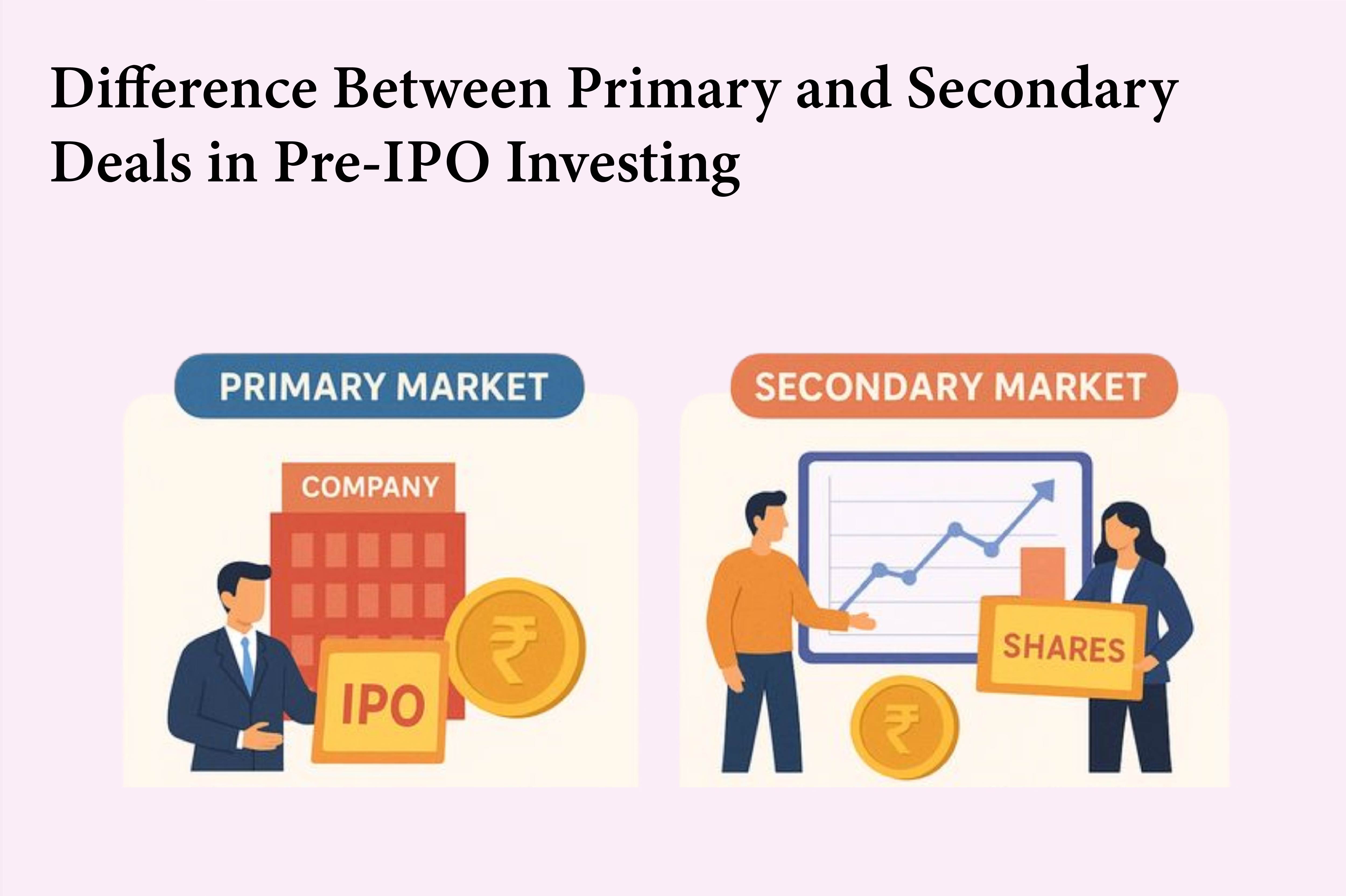
Most first-time pre-IPO investors focus on one thing: finding the right company. They research the product, check the growth numbers, and watch the funding headlines. Then someone offers them shares and they say yes without asking the one question that changes everything.
Where did those shares come from?
That question is not a formality. It determines who gets your money, whether new shares were created, what the seller's motivation might be, and how you should think about the price you are paying. In pre-IPO investing, the answer splits every transaction into one of two categories: a primary deal or a secondary deal. Understanding this distinction is not optional knowledge for serious investors. It is the foundation on which every other pre-IPO evaluation sits.
A primary deal is a transaction in which the company itself issues new shares and receives the investment capital directly.
When a startup raises a Series A, B, C, or any subsequent funding round, it is conducting a primary transaction. Investors pay for newly created shares, the money lands on the company's balance sheet, and the business puts that capital to work: hiring talent, building infrastructure, expanding into new geographies, or accelerating product development.
The word "primary" is accurate. You are buying at the source. The company is the seller. Your investment is directly tied to what the company does next.
Indian market example: When Zepto raised its Series D round in 2023 at a valuation close to $900 million, every rupee from institutional investors went directly to Zepto's operations. New shares were issued, existing shareholders experienced dilution, and the company used the capital to fund rapid warehouse expansion across Tier 1 cities. By the time retail investors started asking how to get into Zepto, that round had been closed for months. The same pattern played out with Meesho's Series F in 2021 and PhysicsWallah's unicorn round in 2022. Institutional investors locked in their primary allocations years before the companies became household names.
This is the structural reality of primary rounds in India: by the time the brand is visible enough to generate retail interest, the primary window is already shut.
A secondary deal is a transaction in which an existing shareholder sells their shares to a new buyer. The company plays no role. No new shares are created. No money reaches the business. Ownership simply transfers from one party to another.
The people selling in secondary transactions typically fall into a few recognisable categories.
An early employee who received ESOPs as part of their compensation three or four years ago. They have vested their shares, the company's IPO keeps getting pushed back, and they have a home purchase or personal financial need that cannot wait another two years for a listing.
An angel investor who backed the company at its seed stage when the valuation was in the tens of crores. The company is now valued in the thousands of crores, their stake has appreciated enormously, and they want to realise some of that gain while remaining partially invested.
A micro-fund or early-stage venture firm with a defined fund lifecycle. They raised a fund in 2018, committed capital to companies through 2020, and now need to return proceeds to their own limited partners as their fund approaches maturity.
A promoter quietly diversifying personal wealth as the company approaches a listing and lock-up periods come into view.
Indian market examples: Through 2022 and 2023, substantial secondary activity was visible across companies like Groww, Ola, PharmEasy, and Boat. ESOP holders at several of these companies used secondary platforms to convert vested shares into liquidity. At PharmEasy, some secondary transactions occurred at meaningful discounts to the last primary round, reflecting how secondary pricing can diverge sharply from institutional benchmarks when business momentum slows. At Groww, secondary demand remained strong as the company continued scaling. Two companies in the same market phase, with very different secondary dynamics, because the underlying fundamentals told different stories.
Before any other analysis, ask this: when I send my money, who receives it?
If the company receives it, you are in a primary deal. If an individual or institution that already holds shares receives it, you are in a secondary deal. Everything else, including dilution, pricing logic, seller motivation, and risk profile, flows from this one answer.
Your Capital's Destination Shapes Its Purpose
In a primary deal, your capital directly funds what comes next. New hires, product launches, geographic expansion, technology infrastructure. You are not just buying a financial position; you are participating in a chapter of the company's story that has not been written yet.
In a secondary deal, you are buying someone else's existing stake. The company's trajectory continues exactly as it would have without your transaction. Your role is purely financial: you are exchanging cash for a claim on future value that someone else decided to exit.
Neither structure is inherently superior. But they serve different investor purposes, and conflating them leads to poor decision-making.
Dilution Only Happens in Primary Deals
When a company issues new shares in a primary round, total shares outstanding increase. Every existing shareholder's percentage ownership decreases proportionally. This is dilution, and it is a normal cost of equity financing.
Secondary deals create zero dilution. Existing shares change hands. The total share count stays identical. If you buy into a secondary deal today, you will not be diluted by that transaction, though future primary raises will still affect your ownership percentage.
This has real implications for return modelling. A retail investor who buys into a late-stage secondary deal in a company that still has one or two primary rounds before its IPO needs to factor in how those future raises will compress their percentage ownership before the listing.
Seller Motivation Carries Information
Every secondary deal has a seller, and sellers have reasons. Understanding those reasons is part of your due diligence, not an optional conversation.
Routine motivations include fund wind-downs, employee liquidity needs after long vesting periods, and portfolio rebalancing by angels who are over-concentrated in a single position. These are normal and tell you nothing alarming about the company.
Less comfortable motivations exist too. An insider who has concerns about the company's competitive position, regulatory exposure, or leadership stability may want to reduce their stake before those concerns become public. You will not always be able to distinguish between the two scenarios, but asking directly, and pressing for a specific answer rather than accepting vague reassurances, is always worth the effort.
A credible intermediary with a clean deal to offer will answer that question without hesitation.
Primary Pricing: Anchored in Institutional Negotiation
When a primary round closes, the valuation that gets reported in the news emerges from weeks or months of negotiation between the company and institutional investors who conducted detailed due diligence. Comparable transactions were analysed, growth projections were stress-tested, and term sheets went through multiple drafts. The resulting price carries real weight behind it.
Secondary Pricing: Derived, Not Negotiated
Secondary prices are typically expressed as a discount or premium to the last primary round. But that benchmarking process is much looser than the original institutional negotiation, and several factors can distort the result.
The last primary round may be twelve to twenty-four months old. If the company has grown substantially since then, a price at the last round's valuation might genuinely be a bargain. If the company has missed targets, faced regulatory setbacks, or seen key leadership depart, a price at the last round's valuation might be significantly overpriced despite appearing unchanged.
The seller wants to maximise their exit price. The intermediary facilitating the transaction has its own commercial interest in closing the deal. Neither party is incentivised to tell you the price is too high.
What looks like a discount may not be: A secondary price offered at 15% below the last round can mean several things. It might mean the seller is motivated and willing to share upside with a new buyer. It might mean liquidity for this company's shares is structurally thin and the discount reflects the difficulty of finding buyers. It might mean the business has deteriorated since the last round and the discount is the market's honest adjustment.
Cheap relative to the last round is not the same as cheap in any meaningful absolute sense. Interrogating how the price was derived, what the most current financial metrics look like, and whether comparable secondary transactions have occurred recently is work that must be done before, not after, committing capital.
Conditions That Favour a Primary Deal
The company has articulated a specific, credible use of proceeds tied to identifiable growth levers, not vague general purposes. The round is being led by an institutional investor with deep sector experience who has conducted independent diligence. The valuation has been set through rigorous negotiation with professional buyers who had real alternatives. You want your capital directly contributing to the company's next phase of growth and are willing to accept dilution from future rounds as a natural cost of that participation.
Conditions That Favour a Secondary Deal
Primary access to the company is closed to you but the business fundamentals justify investment at the current valuation. The seller's motivation is specific, verifiable, and routine: a fund reaching its lifecycle end, an employee who has waited five years for a listing that keeps slipping, an angel rebalancing a concentrated position. The secondary price is at or below the last primary round and is defensible against current business metrics, not just the historic benchmark. You have explicitly modelled how future primary rounds will dilute your ownership before the IPO and confirmed the return potential still holds under those assumptions.
In both cases, the quality of the underlying business and the price you pay matter more than the deal structure. Structure tells you which questions to prioritise. It does not substitute for fundamental analysis.
Here is what most pre-IPO content in India does not say clearly: the overwhelming majority of what retail investors access in the Indian pre-IPO market is secondary supply.
Companies like Swiggy, Ola Electric, Meesho, Boat, PhysicsWallah, and similar names completed their institutional primary rounds long before they appeared on retail investors' radar. By the time a startup is prominent enough to generate organic retail interest, the primary rounds are years closed. What becomes available on secondary platforms, through intermediaries, and via wealth management channels is secondary inventory: ESOP holders seeking liquidity, angels managing their portfolios, and early funds returning capital to their own investors.
This is not a reason to avoid pre-IPO investing. Secondary transactions have delivered real returns for investors who understood precisely what they were buying, paid a price grounded in current fundamentals rather than outdated benchmarks, and held through to a liquidity event. But the proportion of retail investors who have committed capital to secondary deals without knowing they were secondary, without asking why the seller was selling, and without examining how the price was derived, is high enough to warrant direct discussion.
The deal structure does not determine whether you make money. The company's fundamentals and the price you pay determine that. But knowing the structure tells you exactly which questions to ask first.
| Aspect | Primary Deal | Secondary Deal |
| Share source | Freshly issued by the company | From an existing shareholder |
| Money goes to | Company's balance sheet | The selling individual or institution |
| New shares created | Yes | No |
| Dilution | Yes, existing holders diluted | No dilution from the transaction |
| Pricing basis | Formal institutional negotiation | Benchmarked to last round, separately negotiated |
| Typical participants | VCs, PE funds, strategic investors | Retail investors, HNIs, secondary funds |
| Common Indian sources | Series A through Pre-IPO rounds | ESOP sales, angel exits, fund secondaries |
| Company involvement | Central: company issues the round | None: company is the underlying asset only |
Primary or secondary. The entire distinction is one question: where does your money go?
Primary means it goes to the company. Secondary means it goes to a shareholder who is ready to exit.
Knowing which one you are in does not tell you whether to invest. The company's fundamentals, the price you are paying, the seller's motivation, and your realistic path to an exit all still require your full attention. But the deal structure is the framework that tells you which of those factors to examine first and which questions carry the most weight.
In a market where information is limited, disclosures are not mandated the way they are for listed companies, and pricing can be benchmarked to data that is eighteen months stale, asking the right questions from the start is what separates investors who understand their positions from those who discover the details after the fact.
So ask it. Every deal, every time: primary or secondary?
Once you know that, you know exactly where to look next.
1. Is this primary or secondary?
Any credible party offering shares should answer this without hesitation. Vagueness or deflection on a basic structural question is a signal worth taking seriously.
2. If secondary, who is selling and why now?
A specific, verifiable reason, such as a fund wind-down or employee liquidity need, is a reasonable answer. A vague "the seller wants liquidity" without further detail deserves follow-up.
3. How was this price derived?
What is the reference point, how recent is it, and what has changed in the business since then? A number without context is not a valuation.
4. If primary, what are the specific proceeds being used for?
"General corporate purposes" is the minimum acceptable answer. A detailed breakdown of deployment, tied to specific growth initiatives, is what a serious primary raise looks like.
5. How does the legal transfer work?
Whether primary or secondary, the mechanics of share transfer must be clean and properly documented. Stamp duty paid, shareholder register updated, and a clear paper trail of ownership are not administrative details. They define what you actually own.
